The medieval Japan map rarely behaves like something that wants to help you, which is part of its questionable charm. It tends to suggest directions with the confidence of a drunk poet who insists he absolutely knows the way to Kyoto.
Travellers quickly learn that folding it neatly is impossible, mostly because it unfolds again out of spite. Some say it was designed less for travel and more for encouraging spontaneous humility. Either way it turns even confident tourists into polite question marks at crossroads.
Tea, Paper, and Confused Optimism
There is something comforting about spreading the medieval Japan map out in a tea house while pretending it makes perfect sense.
Locals often glance over, smile politely, and let you continue your theatrical struggle with geography. Many travellers suspect the ink shifts slightly when not being watched though no one can prove it.
Tea houses become unofficial map clinics where patience is served alongside steaming cups and gentle laughter. A traveller once tried using symmetry as a navigation strategy, which impressed absolutely no one.
Still, the ritual of unfolding the paper feels oddly ceremonial, as if preparing for a diplomatic meeting with geography. Every crease tells a story of optimism, error, and stubborn persistence.
Reading the Medieval Japan Map Like a Fortune Teller
You hold it up to the light as if it might reveal secret instructions if treated with enough respect.
Many travellers eventually realise the medieval Japan map is less a guide and more a personality test written in ink and stubborn optimism. It rewards confidence more than accuracy, which explains a great deal about historical travel reports.
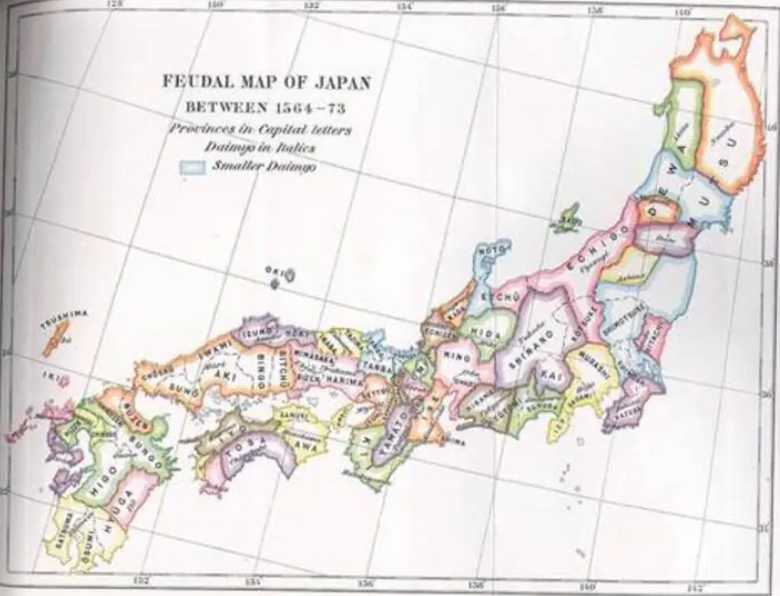
This medieval Japan map is a feudal map of Japan that spans the entire Japanese archipelago, but it zooms in with remarkable detail on regions where the fiercest battles and power struggles took place.
A nearby monk might offer directions that contradict everything you have just decoded. Even the ink seems committed to drama, refusing to behave like modern cartography expects. Visitors often develop theories about hidden jokes embedded in the coastline drawings. These theories are fervently advocated over lunch, but none of them are proven. A poorly executed turn has the potential to become the day’s high point.
Detours That Become Main Events
Travels that start with assurance and finish with unexpected nibbles are the greatest. Every incorrect turn seems to lead to a festival, a temple, or an opinionated, amiable dog.
Travellers share tales of illogical paths that nonetheless increased their desire for adventure. Markets appear where no map predicted them, as if geography enjoys improvisation.
Locals treat confusion as a normal weather condition, slightly amused but unbothered. A wrong turn might lead to better food than the intended destination ever promised. It becomes difficult to classify any route as incorrect after a while.
Final Thoughts from a Wandering Paper Enthusiast
Eventually you stop treating navigation as a science and start treating it as performance art. The humour comes from accepting that certainty is optional and curiosity is mandatory.
Navigation becomes less about arrival and more about storytelling potential. Rather than measuring their travel success in terms of miles, travelers are now beginning to evaluate their success based on how much they laugh during an adventure. Getting lost no longer feels like an error in judgment but rather a required component of the journey you’re taking.
Geography of Japan Medieval Japan Map Activity & Medieval or Japanese Feudalism System Daily Life Instructomania
The most memorable trips often come together through the raucous chaos created by people putting pencil to paper, making assumptions about their locations and levels of self-assuredness and miscalculating. People will fondly remember these types of trips long before they actually experience them, right up until they sit down with a group of other travellers to begin planning their adventures; the quietness of a planning meeting often hides all of these wonderful adventures behind a wall.
Every traveller is reminded by the medieval Japan map that laughter is the only trustworthy compass and that direction is negotiable.